
RH Vacuum Degassing: The Road to Premium Steel
If LF is the beauty salon, RH is the custom workshop — automotive sheet, electrical steel, linepipe, heavy rail nearly all pass through it.
What Is RH?
Ruhrstahl-Heraeus vacuum circulation degasser: a vacuum vessel above the ladle with two snorkels (up-leg, down-leg) into the steel. Vacuum pumps draw the vessel to 0.1~1 kPa; pressure differential lifts steel up the up-leg, degasses it in the vessel, and it returns via the down-leg — continuous circulation.
Capabilities
1. Degassing H: ultra-low H partial pressure forces hydrogen out, 5~8ppm → below 1~2ppm, eliminating flakes.
2. Deep decarburization: C reacts with O under vacuum as CO — down to 20ppm C. Essential for IF/electrical steels.
3. Deoxidation and inclusion removal: circulation promotes flotation; Al can be added for clean steel.
4. Composition trimming: alloy hoppers on the vessel wall.
5. Heating/cooling: Al-oxygen thermite (RH-OB) or circulation control.
Temperature Behavior
Natural cooling ~1~2°C/min; circulation accelerates it; alloy additions cool too. Station-in temperature must be pre-high by 30~50°C over the exit target — gauged by precise pre-RH measurement. Periodic in-process measurement prevents cold, sticky steel.
RH and Hydrogen Determination
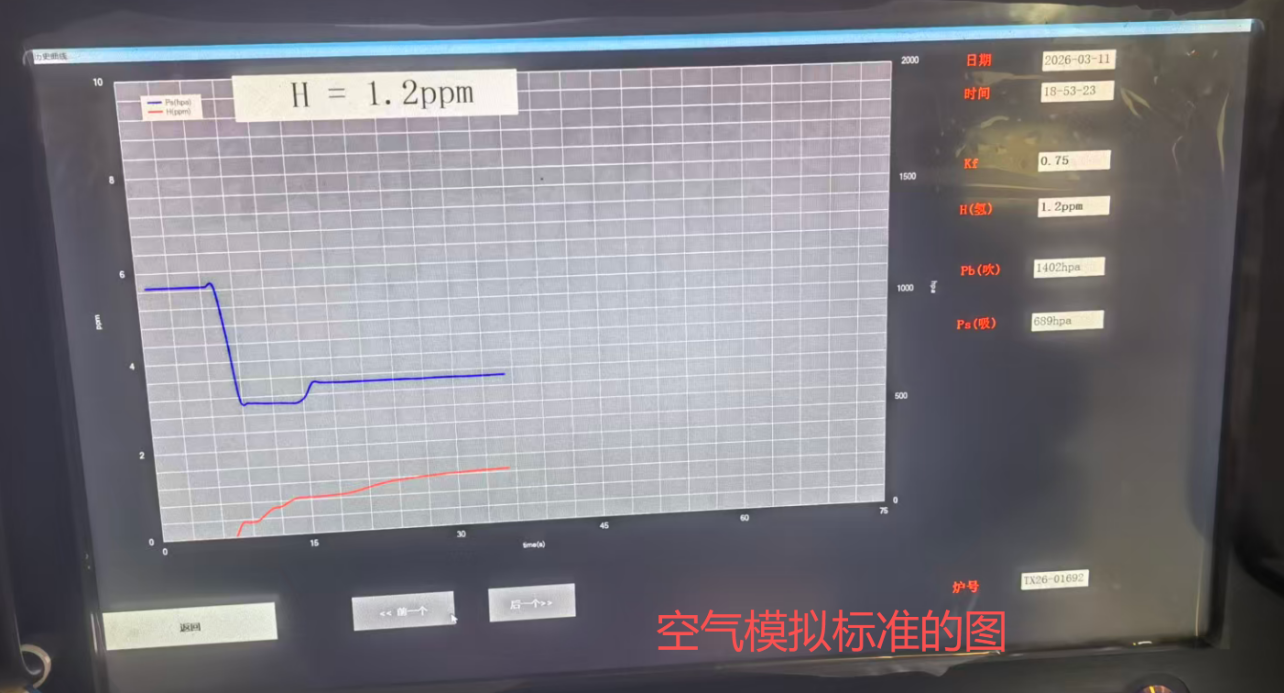
Verify degassing with a hydrogen analyzer: measure before and after; break vacuum only when H < target (e.g., 2ppm). Probe inserted, carrier gas circulates, result in 1 minute — the direct report card of RH.
Summary
RH uses vacuum to suck out hydrogen, carbon and inclusions — the road to premium steel. Every stage's temperature control and degassing verification rely on measurement equipment.